


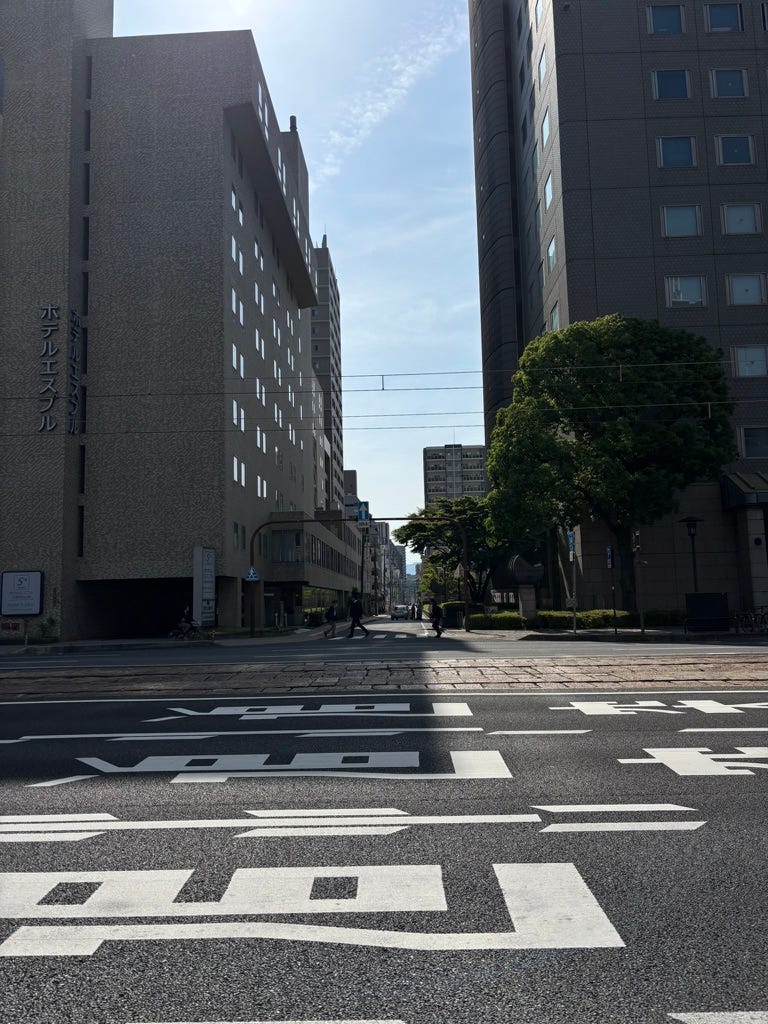
HIROSHIMA, Japan — The employee kindly rolled my film into a canister since I had no idea I needed to, much less how to. I began to fill out the forms and even paid.
“Four days,” he told me. “Come back in four days.”
I winced, then responded, “I won’t be here in four days.”
We stared at one another. “Can you email it?” I asked, hopeful.
“No,” he replied, cordial.
He asked, awkwardly, “Refund?”
I responded, awkwardly, “I guess?”
Then I followed up, “Are there other places to develop film here?”
He thought for a second. “No.”
I sauntered back to the hotel and assessed the state of affairs. The entire point of shooting the first roll of film, a test roll, appeared defeated—I would have to wait until we arrived in one of the larger cities of Kyoto or Tokyo to develop my shots, meaning I won’t know if I should adjust any mistakes from the test roll. Then an appealing third option crystallized: What if there was another place in town to develop film?
Film is not often the first topic to spring up when talking about Hiroshima. Because of its tragic and fabled history, I was unsure what to expect in Hiroshima other than a sense of sorrow that, I was confident, would permeate the town. However, when we arrived at the modern Hiroshima Station and took a pastel street car through bustling streets and lively commercial districts, I was surprised.
To be honest, you would have no idea that Hiroshima ever saw such devastation. At first, I felt sort of uneasy—it felt like the city was trying to shed its harrowing past. But what a testament to the city’s tenacity it is to have everyday life, and so much of it, in full bloom: corporate employees briskly walking to work in formal attire, parents and their kids strolling in the park, scents and flavors wafting from restaurants and cafés.
That is not to say Hiroshima has moved on. Survivors of the 1945 destruction are still alive, though their numbers have dwindled; descendants abound. The Japanese government has invested heavily in projects like the Hiroshima Peace Park and scores of other monuments and museums around town. The world’s most powerful people, from popes to presidents, have paid their respects at the city’s near-constant stream of peace conferences, anti-nuclear summits, and solemn memorials.
On our last afternoon in town, I hopped straight on a city bus toward Hiroshima Station, where a number of large electronics retailers surely offered an option to develop film. Traffic clogged Hiroshima’s streets, but cars didn’t honk and pedestrians didn’t jaywalk. I, too, waited my turn at a few streetlights before walking into a glowing mass of phones, computers, and cameras at the first store—then the second, then the third. I will have to wait until Tokyo and, all things considered, that feels okay.
🇯🇵 Read more from Japan.