


Glancing between Google Maps and the guard in brown uniform standing before me, I tried in vain to communicate what, exactly, I was looking for.
“It’s called the Portuguese Landing Monument,” I said, pointing at the purple dot on my phone. “It should be right through here.”
The customs authority guard called over a few of his colleagues, each of whom took a look at the map, equally befuddled. It was clear nobody knew what I was talking about.
“Can I go in?” I eventually asked, politely.
The group of men, several of whom wielded automatic weapons, seemed to take a second in collective thought.
“Sir,” one began. “This is high security.”
And so it was a no-go on the Portuguese Landing Monument, whose single one-star rating on Google Maps piqued my curiosity. An accompanying photo appeared to show the royal Portuguese coat of arms carved into a small stone. Years ago, I’d be unsurprised if it was rather easy to access the monument — even if nobody really did.
These days, Colombo’s historic port looks dramatically different. About two years ago, the Sri Lankan government and a Chinese company signed an agreement that has since seen a Dutch-style land expansion into what was once a harbor where fishing trawlers and cargo vessels docked. Where open-air promenades once lined the ocean, armed guards now patrol construction sites and shipping lanes — and, it turns out, Portuguese landing monuments.
As I wandered down the street defeated, a warm elderly man on a bicycle outside a building that turned out to be a museum pointed me in. First I asked where I could find a bottle of water. Across the street at the Sri Lankan navy mess hall, I squeezed past officers and sailors to get to the fridge and fished a couple coins from my pocket.
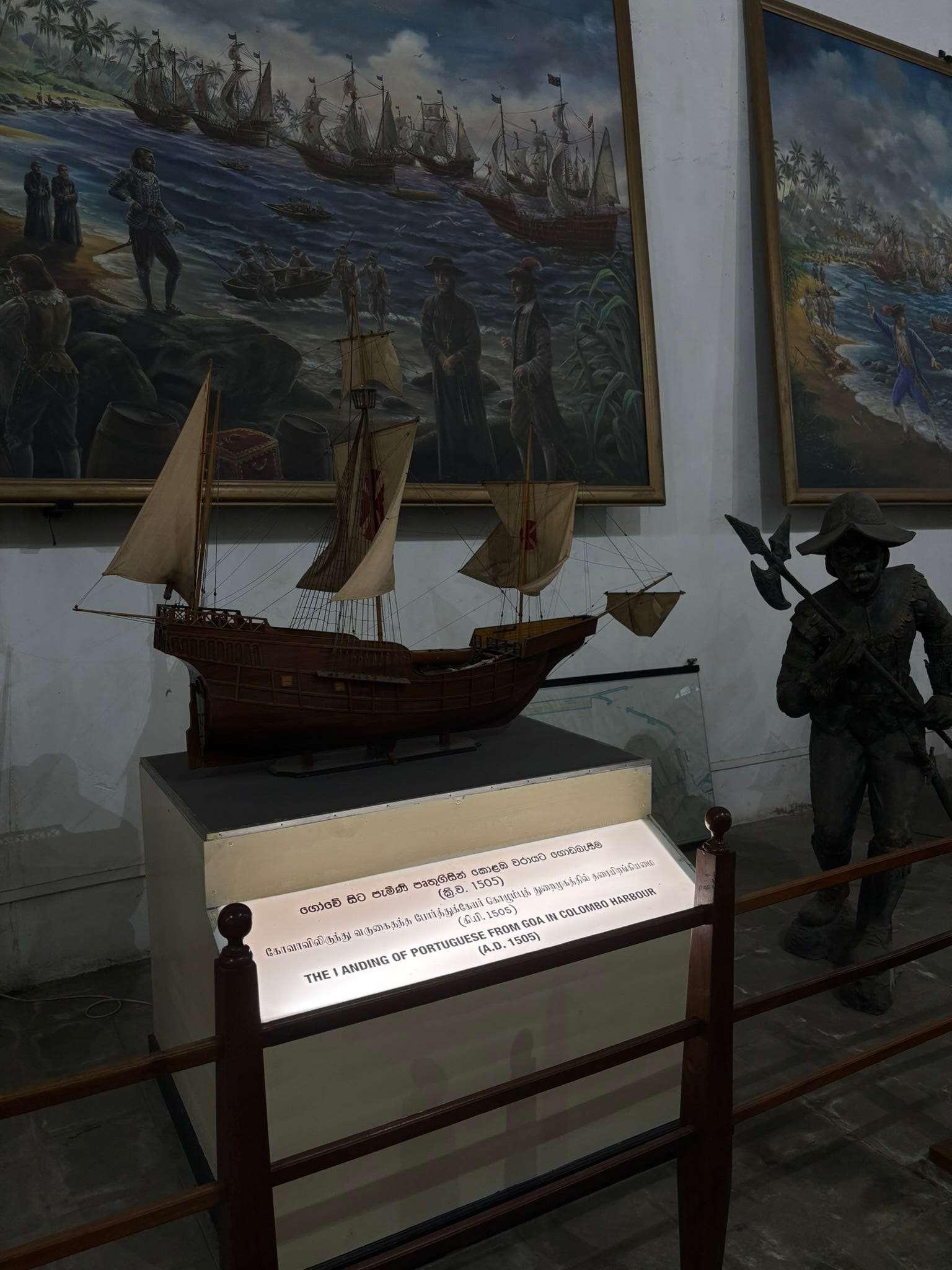
Inside the museum I look at a rather extensive display of small replica ships, maritime artifacts, and dozens of exhibits organized chronologically. Mentions of Portugal were rather abundant, which is not surprising given that Colombo’s port blossomed during the colonial era, which began in the sixteenth century with the arrival of the Portuguese. Maybe the landing monument was the friends we made along the way.
🇱🇰 Read more from Sri Lanka.