


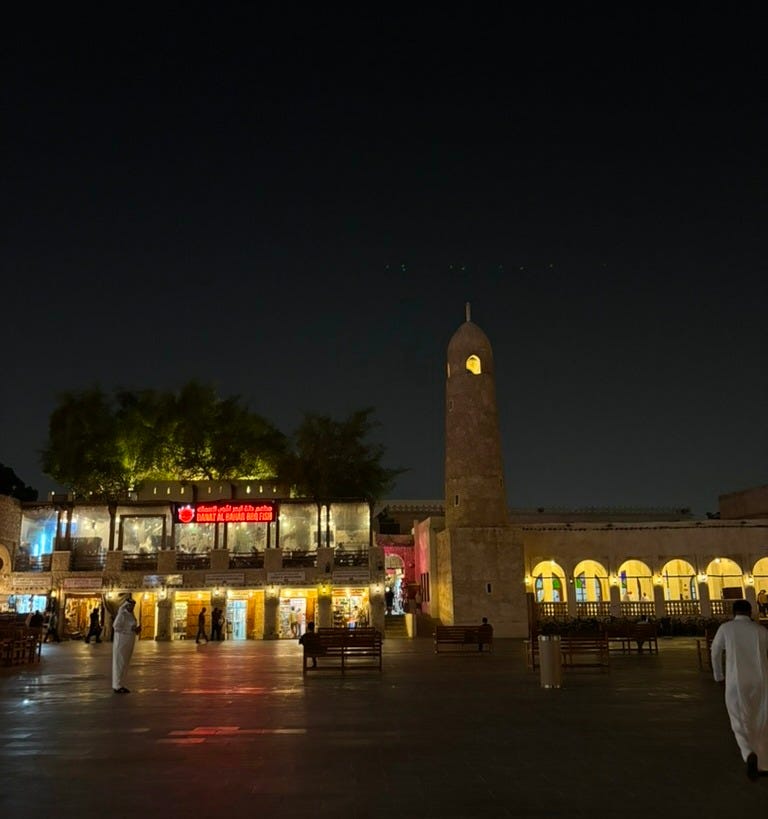
DOHA, Qatar — Nestled in a back corner of the souq, we watched as men in snow-white thobes—the long robe common in this part of the world—chatted in rapid succession and jostled with their tablemates for the prime cuts of meat.
Silently, we took in the cave-like atmosphere with its low-hanging ceilings and whitewashed walls. Just as we contemplated ordering something, my friend—our local tour guide—showed up to join us. He took over the process and soon we, too, jostled with each other for the best pieces of beef and chicken kebab.
The warm riqaq bread, a thin and crispy crepe-like complement to heartier dishes and classic sauces, continued to pile up on the table. “In case the first one got cold,” my friend said, as if it were obvious, in response to our confused glances. We ate the warm one first but managed to finish the colder pieces, too.
Doha is almost like a desert oasis, except its creation was spurred not by a fortuitous source of water but massive oil deposits that have in turn enriched the Qatari state and its capital, which played host to the World Cup a few years ago. Gleaming buildings and their bright lights shimmered high above the charming yet distinctly modernized Souq Waqif, the open-air traditional market in Doha.
“Would you guys like some tea?” my friend asked, just as we met up with another classmate. “Sure,” we responded, imagining something light and refreshing—perhaps even over ice—in the sweltering heat. Instead, the cup warmed and indeed almost burned my hands as we made our way through the souq toward one of Doha’s countless business districts for a tour of our classmate’s office.
“It’s an art museum as well,” she said. And it was: sculptures lined the airy, air-conditioned lobby, and wall signs dictated which floors hosted which exhibits. Out in the square, five-star hotels lined an otherwise empty, even eerie plaza. This is a trade-off in cities like Doha: pockets of exquisite luxury, fine dining, and a general ease of living replace the gritty urban spirit that defines urban centers in other parts of the world.
We were, however, surprised to find that spirit present in other parts of the city. Migrant workers who come to the Middle East to work in its homes, airports, and public spaces have brought with them social centers like restaurants—we saw signs for Uzbek and Somalilander cuisine, among others.
So, of course, both of these things can be true; jet-setters flock to Doha for its indulgent hotels and world-class malls, just as the people who keep those spaces running are able to carve out their own space in the city, too.
🇶🇦 Read more from Qatar.